Reign of Fire

I’m going through some old notes I’d jotted down years ago for the novel I am now rough drafting. I can’t use this scene because it doesn’t fit in the timeframe of the novel, but I still like it.

James and Jessie are watching Reign of Fire when Jessie begins talking about the hotness of Matthew McConaughey.

“But why does he have to always be so dirty and slimy?” Jessie mused.

“Well, it’s not like they have showers,” James replied.

“They fight the fucking dragons with water. What do you mean they don’t have showers?”

“Well, maybe they just don’t have soap.” They watch.

“He could at least wipe his head off with a towel,” Jessie complained.

“And spit out that nasty stump of a cigar that looks like he’s been gnawing on it since the ’70s.”

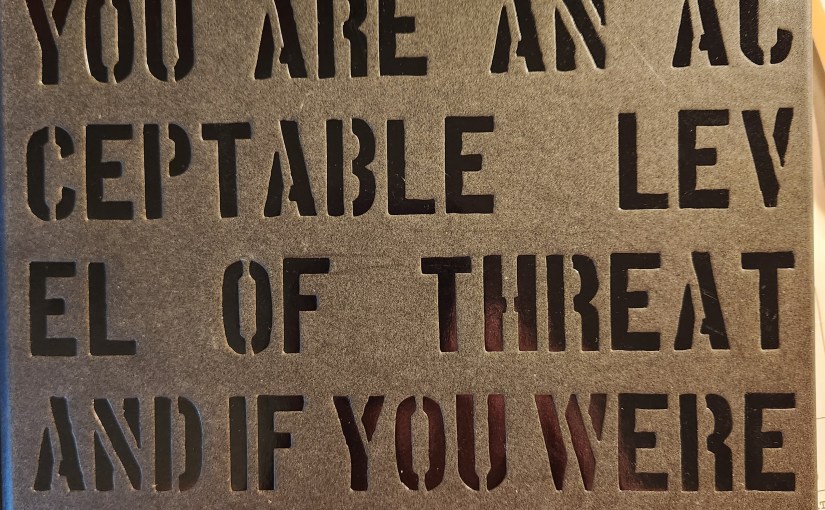
Banksy: You are an acceptable level of threat and if you were not you would know about it

First published in Great Britain in 2012 under the imprint of Carpet Bombing Culture

Compiled and edited to Gary Shove

Words by Patrick Potter

Designed by Lee Crutchley

This coffee table book is glossy and beautiful. There are no page numbers. The creators warn that not all images within the book can be verified as the work of Banksy. This is a book of explanation and light worship; not critique. Some critics are quoted and some rival work is shown. This would be a good book for people interested in learning more about how art reflects and critiques our culture. What follows is a combination of the chapter titles and snippets of Banksy interviews plus some wording by the author, Patrick Potter. 

“Queue here to say books about Banksy aren’t as good as they used to be.”

Diss-claimer

“If you cannot win, knock over the table.”

You are an acceptable level of threat (If you were not, you would know about it)

Banksy Basics (The Beginners Guide)

To Buff or Not to Buff? (That is the Question)

The Power of Denial  “Never underestimate the power of denial.” (AKA–Why we don’t want to know.)

Vandal Incorporated  (Spreading the Gospel)

“Like Banksy, the problem for people who dream of a better world, is that they have to live in this one.”

Banecdotes #1:  Banksy at the South Bank Awards, gets smashed, eats all the canapes

It is unclear who wrote this poem-like-thing, but I like it:

Write your name.

The first thing they teach you at school.

Write your name.

Sign for your first bank account.

Write your name.

At the top of your exam paper.

Write your name.

One the back of your bedroom door with a drippy pen.

Write your name.

To log in to Facebook.

Write your name.

Write your name.

Write your name.

As if you existed.

As if you were unique.

As if you were separate.

In your name.

The things you own are in your name.

Your name.

That which owns, that part of you which may possess things.

And that part of you that possesses your crimes 

And your crimes against possession.

Write your name on the police report.

Write your name on the caution.

Your name was written on you.

Write your name.

One Nation Under CCTV  (Pop Quiz!)

“I need someone to protect me from all the measures they take in order to protet me.”

Big Brother is Watching You (You Can’t Fool the Children of the (CCTV) Revolution)

Welcome to the Hood (Art and rebellion)

Veteran art critic Brian Sewell wrote, “He is a complete clown and what he does has absolutely nothing to do with art.”

“Dear Brian, when criticising art in return for money,.please try to remember who the parasite is in this relationship.”

Everybody is in the Place (In My Opinion)

Banecdotes #2:  Banksy does all his own work, or not

“Live the dream. Endure the nightmare.”

NOLA Rising (Banksy vs. The Grey Ghost)

“I came to New Orleans to do battle with the Grey Ghost, a notorious vigilante who’s been systematically painting over any graffiti he can find with the same shade of grey paint since 1997. Consequently he’s done more damage to the culture of the city than any section five hurrican could ever hope to achieve.”

Banecdotes #3: Free the Dolphin

Banksy Taken Out of Context  (Have Powertools will Travel)

“Ah, that’s the key to graffiti, the positioning.” –Banksy

Patrick Potter: “Well, think about it; if you write your name on your own living room wall, it’s not graffiti, it’s interior design. Positioning can’t get more crucial than that. Where it is determines what it is.

(Surely, graffiti on a legal wall is actually a mural?)

“So much of Banksy’s street art depends on its position to make it really work. Some like ‘This Looks a Bit Like an Elephant’ depend entirely on location for effect. Some get a great punchline out of a strange location, such as the Penguins at Barcelona Zoo. Some are just, well, in the right place and at the right time, such as his ‘I don’t believe in anything, I’m just here for the violence’ placards at the 2003 May-Day march in London.”

How to Turn Invisible (Karma and the Urban Chameleon)

“You will need: a high visibility vest, a hard hat, a clipboard, some business cards, an unmarked van.

Animal Army (Hasta La Vista Heavy Weaponry)

In 2006, Charlie Brooker for Guardian Online wrote, “Banksy is clearly a guffhead of massive proportions, yet he’s often feted as a genius straddling the bleeding edge of now. Why?”

Unknown reply: “Mr. Brooker, cutting edge gatekeeper, is obviously stunned by the idiocy of the general public. He’s right of course. We can all agree on one thing: Everyone else is an idiot.”

The Nakodar Curry House Miracle (It’s Twice as Spice)

“The poet produces poems. The painter produces paintings. The criminal produces crimes. If you can do all three at once, you’ll really confuse the shit out of them.”

Blatantprovocation

Banecdotes #4: A Brief History of Stencil Graffiti

“Crime against property is not real crime.”

“There are four basic human needs; food, sleep, sex and revenge.”

Handbags at Dawn (Banksy vs. Robbo)

“Graffiti is one of the few tools you have if you have almost nothing. And even if you don’t come up with a picture to cure world poverty you can make someone smile while they’re having a piss…”–Banksy

Vandalism Vandalized (Banksy’s Silent Disco)

Cash for Credibility (Buying into the counter culture)

Banecdotes #5: Who Let the Dogs Out?

“Sometimes the right thing to do…is the wrong thing.”

Belly of the Beast (Has Banksy got his heart set on breaking America?)

Banecdotes #6: Light Group elated over Possible Banksy Piss Take

First Time as Property Damage (Second Time As Theft)

“The greatest crimes in the world are not committed by people breaking the rules but by people following the rules. It’s people who follow orders that drop bombs and massacre villages.”

Oh Little Town (Of Bethlehem)

The Art of Resistance  (Where next for Palestine?)

Swing Low Sweet Charity (Robbing the Rich to Pay the Poor)

“Only when the last tree has been cut down and the last river has dried up will man realize that reciting red Indian proverbs makes you sound like a fucking muppet.”

Banecdotes #7: Thieving Banksy

“Never play.”

Bankstonbury  Festival (Don’t Worthy–Be Hippy)

Banecdotes #8: Hanging out with Danger Mouse

Toxic Love (I’m Addicted to You)

Rise up! Occupy! No Banks, No Borders, Do Not Pass Go, Do Not Collect 100 [dollars] (Games the 99% Play)

“All action and no theory: Tox. The middle ground: Banksy. All theory and no action: You?”

The Great Art Swindle (Subverting the Kunst Market)

“People in despair buy more shit.”–Potter

“Graffiti doesn’t always spoil buildings. In fact, it’s the only way to improve a lot of them. In the space of a few hours with a couple of hundred cans of paint, I’m hoping we can transform a dark, forgotten filth pit into an oasis of beautiful art–in a dark, forgotten filth pit.”

Can It (Gentrify that!!!)

Banecdotes #9: The real meaning of Christmas

“If you want to reach the whole world you have to make the song simple.”

Building Castles in the Sky (The other side)

“The people who run our cities don’t understand graffiti because they think nothing has the right to exist unless it makes a profit…The people who truly deface our neighborhoods are the companies that scrawl giant slogans across buildings and buses trying to make us feel inadequate unless we buy their stuff…any advertisement in public space that gives you no choice whether you see it or not is yours, it belongs to you, it’s yours to take, rearrange and re-use. Asking for permission is like asking to keep a rock someone just threw at your head.”

Watching You, Watching Me (or how to be famous for 15 minutes)

“Over the counter culture.”

“Treat this book like soft porn–inspiration for action. Cheer if you want. Boo if you want. You’re still just the audience.”

Originality (Remembering What you Heard. Forgetting Where you Heard It)

 (Dr. Laurence J. Peter)

“It’s a sick world.”

Feel Afraid, Feel Very Afraid (Social Control and The Suffragette)

Meta Tagging (WTF)

Any Last Words? (The Crux of the Matter)

Better Out Than In

Western Echoes of the Harlem Renaissance: The Life and Writings of Anita Scott Coleman

Edited by Cynthia Davis and Verner D. Mitchell

In a preface margin note: It wasn’t her location, but the time period and the topics she discussed that made her a Harlem Renaissance writer. There was a west and east coast renaissance. After the preface the book contains an “Anita Scott Coleman Chronology.”

Introduction: Anita Scott Coleman in the Southwest

“…the issue of where an African American family should locate its physical, moral, and spiritual ‘place’ or home becomes an important theme in Coleman’s oeuvre.” She was able to share more with family than with the public. “…home is not a restrictive space or a domestic prison for women, or even an escape from racist reality, but a site of agency for the African American family. Home thus functions as both a response to and a goal of migration and diaspora…” (5). Coleman’s grandmother was marked as mulatto on the census, probably from Seminole heritage. “Coleman’s poem ‘Hands,’ like ‘America Negra’ and ‘El Tisico,’ weaves together family history, the theme of home and migration, and biblical allusion to explore important issues in African American history” (6). “…African American presence in New Mexico and Arizona, the race has contributed to the region’s development since the time of the first Spanish explorers.” Some became “linguists and translators of Native American languages” (10). The lived in a town that reminded me of the all-Black town where Jodi and Janie live in Hurston’s book Their Eyes Were Watching God. “American history, in its persistent attempt to eradicate the black presence in the West, not only ignores the participation of blacks in law enforcement, but edits out their connection with legendary American outlaws.” “…two African Americans rode with the posse that eventually killed [Billy the kid]. Blacks were actively involved in law enforcement.” “…25 percent ‘of the 35,000 mean who went up the trail from Texas with herds during the heroic age of the cattle industry, 1866-1895…were Negroes'” (Porter 347) (14).

“Coleman seems to have enjoyed an unusually close relationship with her parents, with whom she lived until their deaths. According to family members, Coleman enjoyed a privileged childhood under her mother’s watchful eye (Caffey; Green). While other children might ‘wallow at will in the dusty street,’ Anita, ‘in stiffly-starched gingham and ribbon bows in her hair…spend her time among the flower-beds, playing ‘a’leery’ with her rubber ball, or mimicking grown-ups with her dolls and tea set’ (‘…G’Long, Old White Man’s Gal…’). In turn, Coleman provided the same meticulous attention to her own children; her daughter Willianna started kindergarten in ‘a frilly white dress and spotless white soxs and shiny black shoes'” (W. Coleman 4) (16). Later, Anita employed her father’s use of irony as a way to treat issues of racism and discrimination in her work” (17).

Coleman graduated from high school. “Her parents encouraged her self-esteem and taught her to be proud of her race and to value character and spirituality over physical attributes, qualities she passed on to her children, grandchildren, and foster children” (Green). “Coleman’s characters are undaunted by hegemonic standards of beauty to which they do not conform and are blessed with strong, protective, and intelligent families” (19).

“Anne, in being willing to take ‘pot luck’ and chance her future with Jim, is rewarded with stability and love. Significantly, Coleman names the couple in the story after herself and her husband, James Harold Coleman. the initial encounter of the fictional pair does, in fact, resemble their meeting: Anita saw James walking down the street one day ‘and just decided he was the man she was going to marry’ (Green). Their relationship inspired a number of stories in which a privileged woman wisely, if unconventionally, chooses a man of sterling character but of lesser status. The positive male-female relationships in ‘Silk Stockings,’ ‘Pot Luck,’ ‘The Little Grey House,’ and ‘Bambino Grimke’ all originate in such intuitive, spontaneous, life-altering decisions as the one Anita apparently made upon seeing James. Like the couple in ‘Two Old Women,’ they may have courted for some years while James solidified his economic prospects. In October 1916, they married and moved in with Anita’s parents on the ranch” (20-1).

“Home is thus a site of empowerment for both men and women, and a shred entrepreneurial venture is a form of resistance to racism. In the same way that Coleman’s father and grandfather seem to have inspired Coleman’s older black male characters, so her husband appears to be the model for the younger generation who are sensitive, intelligent, and skilled. Unfortunately, they are also frustrated in their attempts to establish themselves professionally.” “Coleman’s mean are complex, nuanced, and believable” and they “behave in a variety of ways” (22). “The tension in Coleman’s stories arises from the reader’s connection to sympathetic male characters who must find their way out of unjust and discriminatory situations” (23). “Although the characters were rural Southerners, they expressed themselves in proper English, instead of in stereotyped dialect” (25).

“Not surprisingly, considering that he personally read and critiqued Coleman’s submissions to the Crisis contests, W.E.B. DuBois became an important influence on the content and style of her work. Although she apparently admired Booker T. Washington during her college years, her stories about the underemployment of skilled black men indicate that she perceived the flaws in the Tuskegee model. She would undoubtedly have read the 1914 editorial in the Crisis in which DuBois asserts that vocational training will never achieve Washington’s aims since there was never any intention on the part of white industry to hire black graduates of trade schools. In several of her stories, Coleman dramatizes DuBois’s critique of the Tuskegee model and the pointlessness of vocational training given the structural inequities in hiring practices” (26).

Coleman wrote stories of passing: “Three Dogs and a Rabbit” and “The Brat.” “Like Johnson, she explores passing as subversion and posits race as a social and economic construct. Coleman’s preoccupation with alienation and isolation, the psychic costs of passing, gives her work a particularly modernist affiliation. “The Brat” borrows Johnson’s trope of African American music as a ‘symbolic projection of a double consciousness’ (Baker 21). Both Coleman’s and Johnson’s protagonists agonize between embracing black culture through music and using music to disguise their origins. Music thus functions in Coleman’s text as both an escape from and a marker of race.” “Coleman thus sets the stage for a fairy tale of race, shape-shifting, and metamorphosis” (28). Charles Chesnutt has a similarly-themed story to Coleman’s: “The biblical allusion to Moses and Miriam, and Jennie’s sacrifice in giving up her child, underscore the terrible psychic cost of passing.” “Kane’s secret makes him ‘lonely, so lonely. His poor heart aches and he can’t tell why.’ Coleman then suggests that Aggie too is passing; after all, the reader only has Jennie’s word that Aggie is white, and of course she was mistaken in assuming that her friend Biddy was black. Both Aggie and David Kane, then, choose the white world but at great cost to their psychic integrity and emotional stability” (29).

“The second frame is Mrs. Ritton’s story. Accused of sheltering a ‘runaway Negro’ pursued by the police, she refuses to divulge the fugitive’s location; instead she tells the court that as a young slave girl (the courtroom gasps in disbelief), she made the arduous journey west with her owners. On the trail she protects a frightened rabbit being pursued by her master. Despite her own hunger and the beating received from her master, she hides the animal. The master’s son observes the flogging, and although he had always teased and annoyed her, ‘he changed from that day.’ The two eventually marry, and Mrs. Ritton’s racial identity is absorbed and obliterated in her social position until the day that she sees the fugitive and has a sudden flashback to the events of her youth. Phipps, although he ‘knew the fugitive was free, and making a rough guess at it, likely to remain so,’ is overwhelmed by the lovely woman ‘standing alone in the midst of all those hostile people, tearing apart with such simple words the whole fabric of her life.’ Even without knowing the surprise ending, one can see how Coleman approaches the theme of passing as a social construct and explores issues of miscegenation and racism in the legal system, all within the framework of a western ‘tall tale'” (31).

Since I’m a huge movie/tv buff, this next bit of information earned a margin note of: awesome! “Finally, the medium of film clearly shaped Coleman’s writing. While writing ‘Three Dogs’ Coleman worked as a script writer for Pathe films; she understood the syntax of film narration, including flashbacks, fast-forwards, dissolves, fades, visual symbols, compressed dialogue, and scenes that are both intimate and dramatic, all of which appear in her work. Coleman remained interested in writing for the media all her life; later she wrote television scripts, including one for Rod Serling’s Twilight Zone.

“…it is possible that the story editors did not know her race. Coleman describes a similar situation in ‘Jack Arrives’ (1920) when a young black architect wins a contest but does not reveal his race until afterward, confident that his demonstrated talent will supersede any prejudice” (32).

“The Brat”

[random notes on this short story]

“A wild night, a blazing hearth, a rose-lit room, low, sweet music, an over-stuffed armchair and a companion; who can tell a tale of life, as she is–ah, there’s charm and warmth a-plenty.”

“Old Jennie, all twisted and bent with premature age, which wrapped her about like an ill-fitting garment…”

“A night for surprises indeed. Old Jennie esteeming me above my fellows. A pleasing surprise bobbing up to nod at me like daisies on a hillside.”

A wild child who reluctantly gives up her baby so that he can have a better life with white people. The separation has broken her heart and made her grow old. She never reveled her true identity to her son; she just visits once a year like she was his old servant. Eventually, the boy stops seeing her and she must let him go. He becomes a famous singer. he got his singing voice from his mom.

“Three Dogs and a Rabbit”

“The picture had to be finished, Gentleman. The rabbit, no the man–had to be protected. Thank you, Sirs. That is all.’

“Yes,” said Timothy Phipps, pensively. “I was the running black gentleman in the story–” he tilted his head a bit backwards and sideways and laughed. His laughter echoing–joy–joy–joy!”

An ex-slave woman who has a penchant for saving those on the run.

“El Tisico”

A story of patriotism for the U.S. The idea that if you are sick you want to go “home.”

“The Little Grey House”

Two lonely people come together in the little grey house.

“Cross Crossings Cautiously”

“Usually Sam was a cheerful creature. Work and love; love and work, that, boiled down to brass tacks, is the gist of all life…”

“Sam swung around like a heavy plummet loosed from its mooring.”

Did Sam come to a bad end because he was black? Did they take him from Claudia before she could see?

“Jack Arrives”

Dreams come true for Jack who wants to be an architect.

“Bambino Grimke”

The “nobody” finds a way to become somebody by collaring a grifter.

“Bambino: Star Boarder”

Grimke strikes again. Almost ran away with another man’s wife but forgot to show up.

“Rich Man, Poor Man”

Rich little Drusilla who thought she’d never work finally found a compelling reason to do so: love!

“Pot Luck: A Story Tue to Life”

“So if any of you expect Life, Life the capricious woman, to pitch her decorum to the winds and do a handspring for the sake of converting the child of a clod-hopping hodcarrier whose mate is a washwoman, into a finished musician or a distinguished linguist, you simply don’t know Life. It’s far more befitting her caprice to make the sons and daughters of musicians and poets the rag-pickers and scullery maids of tomorrow. If you notice, she takes generations in which to produce and only moments in which to destroy.”

“But a lady–bah, a lady–any female who chooses can be that. Take for instance, a little bit of natural inclination, a fair amount of right association, a smattering of education; and a knack at imitation, and you have it.”

People were surprised that she was so good at her job AND black.

We didn’t think Anne Borden would amount to anything since she didn’t take to education. She was loved by children so she ended up working with them and found love along the way.

“Two Old Women A-Shopping Go! A Story of Man, Marriage and Poverty”

“Tis a trouble men folks be,” offered one.

“But a sweet trouble ’tis,” proffered the other.

“Trouble ain’t never harmed nary one of us. What’s more, us wimens can make men folks what us choose to.”

“Deed so! Us ’tis what makes ’em or breaks ’ems.”

The wisdom of old women is heeded by a young woman who holds on to love while she has it.

“The Mechanical Toy”

“…an old dreaming sentimentalist, it mattered not, that Jonathan Connors was a black lad and Haven Addams a white one. He adored friendship wherever it was found…”

Jonathan saved all his earnings in hopes of going to industrial school. Haven came from money, so would spend what he had.

“They were very young and laughed a great deal and talked overmuch; because youth loves to flaunt itself and is never secretive.”

A prank kills an old man of fright.

“Love for Hire”

An old lady is becoming too chummy with her black house maid according to her children. The maid is so upset at her boss’s death because she might not be able to find another position that high paying. Ahh…so it wasn’t sympathy…it was loss of income she was mourning.

“…G’Long, Old White Man’s Gal…”

Mercy Kent is left a “good sized fortune” by an old white man.

“She hobbled towards the door, then turned and came back. She was like a little black spider in the midst of them, weaving a web with which to catch flies. And the flies, see them, flies will always be caught.”

They talk of white men never leaving black women anything if there weren’t some other exchange involved. There is a description of Mercy’s family growing up.

“There was rejoicing within the little white and green cottage, the sort of joy that bubbles over the rim and splashes down the sides, and makes little puddles about the bottom of the bucket and eventually forms into little rivulets to run here and there and everywhere.”

The black people of the town put down the black family that profits from working for a rich white man. Even with all her money, Mercy will never be accepted by her peers.

“Phoebe and Peter up North”

There is talk of looking whiter to change; to fit in. Peter gets what for when he calls his wife Phoebe a countrified thorn in his side.

“Phoebe Goes to a Lecture”

Birth control is discussed.

“Alright then, ” exclaimed Mayme. “Honey-child, that’s why I urged you to come, not that I thought you’d enjoy that especially, but get out, see with your eyes and hear with your ears, and give your brains an airing. That’s what city life is for, to put the ‘pep’ in living. You don’t need to think other people’s thoughts. Think up your own; but you can’t think looking inside yourself. You’ve got to look out. Do you get me? Then you won’t have time for such nonsense as loneliness.”

Phoebe gets out. She needs to broaden her mind, even if it only leads back home.

The poem “Hands” reminds me of my dad. When one does hard labor all his life these are the hands that are created. Working man’s hands.

The poem “Idle Wonder” Do we only imagine our pets and employees to be contented?
Silver Borne

Final book in the Mercy Thompson series by Patricia Briggs

Phin, the bookstore owner, seems to be missing. Mercy has one of his books about the fae.

Someone (or more than one) from the pack is able to enter Mercy’s head and mess with her thoughts. She wants to learn more about this from Samuel, but he has called for Mercy’s help at the hospital.

Samuel tried to kill himself. His wolf has now calmly taken over until Mercy can figure out what to do.

An unknown named Daphne Rondo sent bounty hunters with a false warrant to bring in Adam. It didn’t work.

Is an unknown woman trying to kill Adam? She gave the kill orders AFTER she’d been missing for a couple of days. Adam knows Samuel is staying in wolf form and is breaking the rules to keep him safe.

I made a note that Briggs came up with a scent I think I’d like as a perfume: earth, forest, magic, wood fire, air and salt water. Make that burning sandalwood and I think we have a hit!

Where is the bookstore owner? Is the fae folklore book important? Is grandma at the bookstore good or bad? Will Samuel still want to kill himself if he turns back human?

Sam and Mercy break into the bookstore and learn it has been destroyed by Phin. They win the battle, but now Adam needs help.

Someone blew up Mercy’s house. Mary-Jo let it happen, but who was working with her?

Gabriel has been taken hostage by the fairy queen who wants to make an exchange with Mercy.

The word “slugabed” is used here which I’ve never heard. Self explanatory though.

Behind the scenes, Mary Jo’s boyfriend, Henry, has been plotting how to get rid of Adam who is the focus of Mary Jo’s romantic wishes. Paul and Adam are set to fight for pack leader.

Fights for control!!

We hear a long-ago story of Samuel and Alicia and how she was tormented by her father. “…scars do not bother me. They are the laurels of the survivor.” The fairy queen has tricked Mercy, Jesse and Alicia into her lair where she is keeping Phin and Gabriel.

Will the group be saved from the fairy queen? Will someone have to stay behind as the queen’s prisoner? Read the fifth and final book in the series of Mercy Thompson!

Bone Crossed

fourth in the series of Mercy Thompson books by Patricia Briggs

Stefan reappears! Marsilia has come to collect on the debt for Mercy killing Andre. An old college acquaintance, Amber, comes to Mercy to help her with a ghost. Stefan is badly injured. He’s at Adam’s recovering. Mercy visits with her mom. Tim’s cousin engages a companion to help deface Mercy’s car shop. Tony is on the case.

Adam and Mercy are now a couple even though she is in constant worry over Marsilia coming to kill her and everyone she loves.

There was a trap set by vampires out to get Mercy. The trap instead turned one of the fae into an ice monster and people got hurt.

In order to turn down the heat in the city, Mercy goes ghost hunting at Amber’s.

Amber and her husband, Corban, know Blackwood as a business associate. Mercy knows him as “The Monster,”; the only vampire in the area. Mercy has no memory of receiving a vampire bit in the night. Is Amber having an affair with a vampire? Stefan? Blackwood? Amber definitely has a ghost problem.

Stefan and Mercy get Amber and her family to a hotel and they head home. Stefan and Mercy exchange blood so that Blackwood can be kept at bay. Vampire Estelle approaches Stefan to ask if he wants to join forces against Marsilia. He refuses.

They hypothesis now is that Blackwood wants to overthrow Marsilia for the Tri-Cities territory. Bernard and Estelle want Marsilia destroyed as well. Stefan will not agree to kill his leader, Marsilia.

Marsilia has her showdown. Estelle is killed, Bernard is allowed to leave. Stefan remains loyal to Marsilia then disappears. No werewolves were hurt.

Adam and Mercy make love. She is still having trouble making a pack connection. Corban shows up to kidnap Mercy. He says Chad has been taken. Is it Blackwood?

The ghost visits Mercy. Blackwood feeds from those whom he wants similar powers. Due to Mercy’s bonds to the pack and Stefan, Blackwood will have to keep her and feed on her over an extended period. The ghost is a vampire he killed when she confronted his behavior. Now the old lady ghost wants to feed on Mercy in exchange for information.

Mercy is becoming stronger through four types of magic: walker, fae, pack and vampire. Does the walking stick end up helping Mercy at all? Will Amber and Corban’s son be saved? Who will clean up this mess? Read volume four to find out!

Iron Kissed

third in the series of Mercy Thompson novels by Patricia Briggs

Zee needs help finding a serial murderer on the fae’s reservation. Mercy is trying to sniff him out. The smell that links all the houses was the rent-a-cop working the gate. Could he be involved in the killings?

Zee and Uncle Mike were on the scene of O’Donnell’s death but don’t know who killed him. Zee is in jail and needs a lawyer.

Mercy goes to the crime scene which O’Donnell’s ghost re-enacts. He says “mine” but Mercy cannot see who ripped his head off.

A magic raven appears then disappears with the magic walking stick. Through talking with Uncle Mike and online research, Mercy is trying to learn more about Zee and the magic stick. Zee is mad at Mercy for “secrets” being shared with the lawyer and police.

Some kids from school attacked Jesse. There will be consequences.

Tim at the bar knows O’Donnell and is part of an anti-fae hate group. Mercy is invited to the next meeting. Mercy has decided on Adam as her future love mate. He seems less controlling than Sam.

The magic stick is following Mercy. Nemane, the magic crow, can take the human form of Dr. Altman. She came to either warn or harm Mercy, but Samuel showed up just in time. Now Nemane knows the type of army Mercy has behind her. The fae are happy for Zee to take the fall for O’Donnell’s death. The others want to keep searching for the real killer. There is a building war.

Fideal is a fae monster who follows Mercy home with deadly intent. The wolf pack has to fight him off.

Uncle Mike, Samuel and Mercy talk about the killer being in possession of some magical items. Uncle Mike says to leave it to the police and the Grey Lords. Mercy doesn’t think they care enough to do a thorough investigation.

A shocking rape occurs by the same person as the killer. He wanted to collect magical fae items and he used an inside man to get them. What does Mercy do to her rapist? What does the wolf pack do before the police arrive? There is some interesting discussion about rape and the psychological issues involved. Mercy will deal with these effects for the rest of the series.

This concludes the three books I had on my shelf. I was having so much fun within the world of Mercy Thompson that I scoured the local bookstore then went online to order the last two books in the series.

Blood Bound

second in the series of Mercy Thompson books by Patricia Briggs

Cory Littleton is a sorcerer vampire. Once Littleton feeds, the spirit of the demon retreats. Littleton has Stephan in a trance and now Mercy’s coyote self is trying to fight him. When Stefan was immobile and enchanted he was engaging in the feeding in his mind. Littleton can kill while putting a spell on another vampire so he/she thinks they did it instead. Daniel is a young vampire who’d been entranced and tricked before. In the altercation, Mercy appears to have gotten a bite from Littleton. Demons can inhabit others but they must be invited. A reporter confronts Mercy at work. She is saved by her friends. She is about to go meet the head mistress vampire to explain what she saw happen at the hotel. Stephan’s trial goes well; they believe him. Now they want him to track down the sorcerer.

Did someone within the seethe tip off Littleton that Stefan was coming to see him that night? Samuel is upset Mercy has been hanging with Adam. He tells her a story about a girlfriend in med school. When she got pregnant she aborted the baby and left him. Sam still mourns this loss.

Side story: Mr. Black has a daughter who is a werewolf. He doesn’t know how to deal and has come to Mercy for help. Warren is nearly killed and left for dead. Now Marsilia is turning to Mercy even though two vampires and two werewolves have not been able to take care of the problem. Stefan is believed dead. Mercy has now been tasked with finding the sorcerer.

Does Marsilia want to own the demon vampire? Mercy has been learning more about vampires. Adam and Samuel (and Stefan) are missing. Littleton pays Mercy a terrifying visit.

Mercy is trying to learn about vampires as she goes. Why is Littleton doing this in the first place? Who is the vampire who made Littleton? Mercy gets more clues about the sorcerer’s location.

Andre, Stefan, Ben, Adam and Samuel are all in the church with Mercy and Littleton. The demon is in full control. Stefan, Sam and Adam are in cages.

Littleton’s head is cut off and the body turned to ash by Mercy. Everyone is checked out at the hospital. Sam kisses Mercy.

Stefan shared the news that Andre’s trial was over. Because Marsilia still wanted a sorcerer vampire, she wanted Andre to try to make one again. Mercy is now searching for Andre. Will Mercy be successful in breaking the cycle that Andre hopes to perpetuate? Will Marsilia get in her way? Read the book for the harrowing conclusion!

Moon Called

first of the Mercy Thompson series by Patricia Briggs. It is interesting how certain people view themselves as particular readers. For example, if someone were to ask, “Are you into fantasy at all?” I’d say no. But…I LOVED the Lord of the Rings series and The Hobbit. Okay…so I can’t think of any others right off the top of my head, but this series by P. Briggs came in handy. After a semester teaching African American Literature which, as one can imagine, can be the heaviest literature of all, I needed something light; something that would totally shift my reading feels. This series was the perfect remedy. The chapters are not super short, but the books are regular sized paperbacks that feel low commitment. Beach reads for the young vampire set. The setting remains the same throughout while also keeping a core group of characters whose relationships grow over time. The romance plot evolves across the series and ends well. The Mercy character is a competent, strong and skilled woman; she makes you want to go out and do stuff. She is not a superhero, so she needs the help of her friends and pack from time to time. I sometimes wished she didn’t need the men in her life as much as she did, but this protagonist is likeable and action-oriented.

We open with werewolves in Washington state. The protagonist, Mercedes (Mercy) Thompson, is a skinwalker who can change into a coyote at will. Tony is an undercover cop. We are in a super natural world where werewolves form gangs and the Grey Lords keep the fae (fairy-like magical beings) in line. Mercy is alone as a skinwalker.

Mac is new to the shape shifter world. He and his girlfriend were turned. He was then captured for experiments and he escaped. They called Adam (the alpha of the local wolf pack) for help but someone else has arrived. People are after Mac. His girlfriend and one werewolf have been killed.

Check out this name: Elizaveta Arkadyevna Vyshnevetskaya. She is a crime scene cleaning witch. Mac (whose real name is Alan) needs to be taught, so he is paired with Adam who will take Mac into his pack. Elizaveta comes to clear the crime scene. Adam takes fingerprints from the unknown werewolf intruder.

There is disruption in the wolf pack. Adam is almost killed and his daughter is missing. They killed Mac and dumped him at Mercy’s door. Mercy takes Mac and Adam out of the situation to out-of-town friends.

We learn about some past relationships. When Mercy’s foster mother, Evelyn, died trying to shape shift, her foster father committed suicide a month later. Samuel, the love of Mercy’s life and a werewolf, never loved her but wanted her for breeding. She was sent away before that happened. Nonetheless, Sam had mourned.

“Livin’s easier than dyin’ most times, Mercy girl,” he said kindly, repeating my foster father’s favorite saying. “Dance when the moon sings, and don’t cry about troubles that haven’t yet come.” Adam, Sam and Mercy are headed back to search for Adam’s daughter, Jesse. They discuss what has been going on.

Warren and Kyle are lovers; one werewolf, one not. Sam, Mercy and Adam are back in town but in hiding. They need a lead on Jesse. [Yea for gay werewolves! I’d like to see this on tv.]

Samuel and Mercy are going with Stephen the vampire to speak with the vampire mistress. Does she know of any stray wolves in the area? Can she lead them to Jesse?

The meeting with the vampires is not going well.

[I am usually not interested in fantasy paperbacks, but this series caught my attention due to the covers which feature a young tattooed woman. I was doing tattoo research at the time, so I bought three of the five books later acquiring the last two. I thought maybe the tattoos gave her power or were magical in some way, but they are not. Nonetheless, here is what might be perhaps the only discussion of tattoos in the series:]

“My tattoo?” I asked, and he yipped–a very bassy yip. Just below my naval I had a pawprint. He must have seen it while I was scrambling into my clothes. I have a couple on my arms, too.

“Karen, my college roommate, was an art major. She earned her spending money giving people tattoos. I helped her pass her chemistry class, and she offered to give me one for free.”

I’d spend the previous two years living with my mother and pretending to be perfect, afraid that if I weren’t, I’d lose my place in my second home as abruptly as I had the first. It would never have occurred to me to do something as outrageous as getting a tattoo.

My mother still blames Karen for my switching my major from engineering to history–which makes her directly responsible for my current occupation, fixing old cars. My mother is probably right, but I am much happier as I am than I would have been as a mechanical engineer.

“She handed me a book of tattoos that she had done and about halfway through was a guy who’d had wolf tracks tattooed across his back from one hip to the opposite shoulder. I wanted something smaller, so we settled on a single pawprint.”

My mother and her family had known what I was, but they’d asked no questions, and I’d hidden my coyote self from them, becoming someone who fit their lives better. It had been my own choice. Coyotes are very adaptable.

I remember staring at the man’s back and understanding that, although I must hide from everyone else, I could not hide from myself anymore. So I had Karen put the tattoo on the center of my body, where I could protect my secret and it could keep me whole. I’d finally started to enjoy being who I was instead of wishing that I were a werewolf or human so I’d fit in better.

“It’s a coyote pawprint,” I said firmly. “Not a wolf’s.” [end]

Sam and Mercy flirt all the way home.

Bran (the werewolf king) and Mercy begin to consider David Christiansen as a suspect.

Bran wants to bring the werewolves public. The witches and Gerry’s lone wolves are against the idea. They’ve got Adam drugged and are holding his daughter.

The team has moved inside to save Adam and Jesse.

Who was behind all this and how were the loose ends tied? Read the last two chapters to find out!

The Route That Made the World: On the enduring romance and eternal influence of the Silk Road

The New York Times Style Magazine  May 17, 2020

[These are little tidbits I found interesting since I am interested in Buddhism…and skulls.]

“How the Buddha Got His Face”  by Aatish Taseer

A renunciant prince gaining enlightenment 25 centuries ago set the Wheel of Dharma in motion. “…a 35-year-old Gautama Buddha, hardly older than Christ when he climbed the hill of Calvary, revealed the eightfold path to liberation from suffering, his four noble truths and the doctrine of the impermanence of everything, including the Self.”

“The Wisdom Tree, also known as the Bodhi Tree,” is what he sat under to work toward enlightenment. “He who was never meant to be god nor ever said one word about god”.

“The memory of the Buddha, however, lived on in the hearts and minds of Indians. They reacted to him as I imagine the residents of Memphis must react to those visitors to Graceland for whom Elvis is God–pleased that he was a local son but alarmed by the ardor of his followers.” 

“Early Buddhists did not regard the Buddha as a divine being but a great teacher. He could not be deified for the simple reason that although Buddhism is not actively nontheistic, it is so reticent on the subject of god as to virtually eschew him.”

“In the omission of the figure of the Buddha,” writes Coomaraswamy, “the Early Buddhist art is truly Buddhist: For the rest, it is an art about Buddhism, rather than Buddhist art.”

Part of Buddhist ethos is tolerance.

“Just as Buddhism had been a reaction to the hierarchical nature of Brahmin orthodoxy in India, so too in China…the Chinese warlords, who had felt disparaged by Confucianism, were attracted to the ‘egalitarian creed.’”

“Sacred images in ancient India were not made primarily as objects of beauty but rather as the expression of a philosophical thought…”

“They were visual aids, ‘born in meditation and inner realization…focusing points for the spirit’…”

“The Buddha, seated in padmasana, or the lotus position, with his legs crossed under him, hands open-palmed in his lap, his face a mask of smiling sagacity and fierce inwardness…”

“The Haunted Place”  by  Aatish Taseer

Turkic conqueror Timur known as Tamerlane in the West, between India and Uzbekistan, killed 100,000 when he erected his famous minaret of skulls.

Only mountains can be more beautiful than mountains.

…inverted Zoroastrian triangles indicating good thoughts, good words, good deeds.

“A Single Thread”  by  Esi Edugyan

Persian word gurg, which means “the land of the wolves.”

Charles W. Chesnutt

1858-1932

Charles W. Chesnutt was the first African American writer of fiction to enlist the white-controlled publishing industry in the service of his social message. His three novels and multiple short stories led him to be the most influential and widely respected African American fiction writer in the U. S. Probing analyses and compelling indictments of racism.

Born in Ohio the son of free black emigres from the South. Grew up in North Carolina during the turbulent Reconstruction era. Attended school regularly and became assistant principal. Moved back to Cleveland in 1884 where he settled his family, passed the Ohio State bar, and launched a business career as a legal stenographer.

In 1887 he produced “The Goophered Grapevine,” his first important work of fiction. Featuring an ex slave recounteur who spun wonderful tales about antebellum southern life. Part of the “plantation tradition” of contemporary southern literature. Presented the lore of “conjuration,” African American hoodoo beliefs. Introduced a new kind of blakc storytelling protagonist, Uncle Julius McAdoo, who shrewdly adapted his recollections of the past to secure his economic advantage in the present, sometimes at the expense of his white employer. 

In 1889 came “Dave’s Neckliss”. Dave, whose downward spiral into delusion, madness, and suicide makes him one of the most pathetic of Chesnutt’s tragic protagonists. Through Dave’s fate, Chesnutt invited his white readers to consider the corrosive effects of being stigmatized on the otherwise healthy mind and body of a sympathetic black man. The stigma of blackness was confronted in order to demonstrate how damaging such an imposed identity could be not only to an individual but to an entire community. 

First book, The Conjure Woman, in 1899 displayed a peculiar mix of realism and fantasy. Appearing during an era when most whites questioned the African American’s capacity for full and equal civil rights, the stories of The Conjure Woman implicity argued that, having confirmed their human dignity and heroic fortitude in the face of the worst that slavery could do, the free black man and woman were amply qualified for the rights and responsibilities of American citizenship.

A second collection of short fiction appeared in 1899: The Wife of His Youth and Other Stories of the Color Line explore the moral conflicts and psychological strains experienced by those who lived closest to the color line in Chesnutt’s day: mixed-race persons like himself. The work received mixed reviews. Some reviewers were put off by his unapologetic inquiries into topics considered too delicate or volatile for short fiction, such as southern segregation and interracial marriage.

In 1899 Chesnutt made the leap to full time writer. He produced The House behind the Cedars (1900), The Marrow of Tradition (1901), and The Colonel’s Dream (1905). Toward this end of this stream of work he began to see sales declining so he again took up his day job.

Chesnutt might have claimed an important role in preparing the American public for the advent of the New Negro author of the 1920s who would focus attention on the real racial issues facing their America.

Historians of African American writing today recognize Charles Chesnutt for almost single handedly inaugurating a truly African American literary tradition in the short story. He was the first writer to make the broad range of African American experience his artistic province and to consider practically every issue and problem endemic to the American color line worthy of literary attention. Because he developed literary modes appropriate to his materials, Chesnutt also left to his successors a rich formal legacy that underlies major trends in twentieth-century black fiction, from the ironies of James Weldon Johnson’s classic African American fiction of manners to the magical realism of Charles Johnson’s contemporary neo-slave narratives. 

The Wife of His Youth

I

Mr. Ryder might aptly be called the dean of the Blue Veins. The original Blue Veins were a little society of colored persons organized in a certain Northern city shortly after the war. Its purpose was to establish and maintain correct social standards among a people whose social condition presented almost unlimited room for improvement. By accident, combined perhaps with some natural affinity, the society consisted of individuals who were, generally speaking, more white than blakc. Some envious outsider made the suggestion that no one was eligible for membership who was not white enough to show blue veins. The suggestion was readily adopted by those who were not of the favored few, and since that time the society, though possessing a longer and more pretentious name, had been known far and wide as the “Blue Vein Society,” and its members as the “Blue Veins.”

Character and culture were the only things considered. They had to be of free birth, but if so, they would have a guide through the social wilderness.

Mr. Ryder is the backbone of the Blue Vein Society. His genius for social leadership was such that he had speedily become its recognized adviser and head, the custodian of its standards, and the preserver of its traditions.

Ryder falls in love with Mrs. Dixon and is throwing a ball for her during which he will propose.

Mrs. Dixon had come to Groveland from Washington in the spring, and before the summer was over she had won Mr. Ryder’s heart. She possessed many attractive qualities.

The thoughts of those of mixed race: “I have no race prejudice,” he would say, “but we people of mixed blood are ground between the upper and the nether millstone. Our fate lies between absorption by the white race and extinction in the black. The one doesn’t want us yet, but may take us in itime. The other would welcome us, but it would be for us a backward step. ‘With malice towards none, with charity for all,’ we must do the best we can for ourselves and those who are to follow us. Self-preservation is the first law of nature.”

Between absorption and extinction.

II

Ryder hears the story of Same and ‘Liza Jane. ‘Liza Jane has been looking for Same for twenty-five years. Ryder gives her all the reasons her plan may not work. 1) he may have died long ago; 2) he may have married; 3) maybe he’s moved up in the world and outgrown you; 4) you may have passed him many times and not recognized him. 

‘Liza shows Ryder an old picture of her Sam.

Ryder gets her address and says if he finds anything he’ll let her know.

III

Ryder uses ‘Liza’s story as a speaking platform during dinner at the ball.

It turns out that Ryder was the man she was looking for. He brought the woman out to the ball and introduced her to everyone as “the wife of my youth.” The audience does not get to know ‘Liza’s reaction. Chesnutt ends the story here.